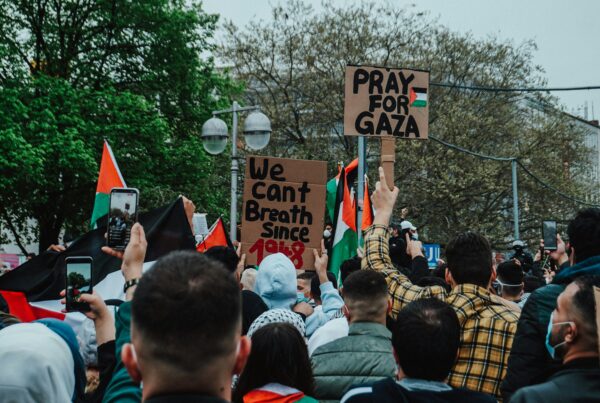



During Lent, we turn our attention to the life, death, and resurrection of Jesus. He lived in a land that was occupied by an empire, walking roads in what we now call Palestine.
Lent invites us to walk with Jesus into solidarity with the people of the land—those who are displaced, marginalized, and unheard. As we reflect on the life of Jesus, we must ask: what does our fasting lead us to do? Who does it move us toward? The Chasing Justice team invites you to join us in boycotting and divesting this Lent so that we may walk in deeper solidarity with the marginalized people of Palestine and across the world. In this post, Lydia El Sayegh invites us to a faith-rooted approach to BDS that she carries from her ancestors.
A Short Introduction to BDS
My Palestinian foremothers and forefathers–under years of oppression–have been pursuing Boycott, Divestment, and Sanctions (BDS) for decades. If you’re unfamiliar, here’s a glimpse of the history:
- In 2005, 170 civil society organizations called for BDS. Tight oppression of the Palestinian people continued under the so-called peace deals of the 90s, and no political power was holding Israel accountable.
- Labor strikes, tax strikes, “victory gardens”, and even 18 cows were key to the Christian and Muslim Palestinians’ uprising. In the late 80s, the first intifada relied on a solidarity economy or resistance economy. This involved community organizing to pursue creative alternatives to participating in the money flow that facilitated oppression.
- In reaction to the British boot of colonialism in the 1930s, women’s committees in Palestine instigated boycotts of foreign and Zionist goods.
These are just a few examples across a century of resistance from my own people’s context.
We can also look at the revolutionary boycotts and alternative economies of the Black liberation movement here in the American South, the South African anti-apartheid movement, and boycotts for India’s independence.
Many of the people (both in the past and present) who are committed to boycott and divestment are faithful followers of Christ.
So it makes sense to ask: Why should Christians boycott and divest? So far, I’ve found five reasons from our faith.
As I go through them in this blog, I’ll frequently refer to the current Boycott Chevron campaign, taken up by US Campaign for Palestinian Rights (USCPR) and by Christians for a Free Palestine (CFP).
1. BDS is a response to oppression that reflects the image of God.
The yearning cry for justice resounds across all sectors. What does God do with cries?
In Genesis 4, God hears Abel’s blood cry out from the ground. In Exodus 3, God hears slaves cry out. Psalm 146:7 proclaims as the psalmist cries, “He gives justice to the oppressed and food to the hungry. The Lord frees the prisoners.”
Let us hear Palestinians’ cries, not so we may “save” them, but so that we may emulate God.
We hear and show up, because that’s what God does.
Right now, the world sees but does not hear. May we be good hearers and better doers of God’s way as we walk in the Boycott, Divestment, and Sanctions movement.
2. BDS purifies us.
Purification, a religious word that is often weaponized, actually has powerful liberatory roots in our ancient faith.
Chevron, as an example, is committed to many evils in this world, including the genocide in Palestine. This corporation has purposefully discharged toxic waste into the Ecuadorian Amazon River; they provide the majority of Israel’s energy infrastructure as Israel illegally turns off and controls energy access for Palestinians, and they have a stake in the construction of the fossil fuel infrastructure project “Eastmed Pipeline,” pending the erasure of Gaza. (Learn more here.)
The guiding Scripture for CFP’s Christians Boycotting Chevron campaign includes an exclamation from God, “Even when you pray for a long time, I won’t listen. Your hands are stained with blood.\ Wash! Be clean!” (Isaiah 1:15-16b). Jesus has an even more jarring command: “If your right hand causes you to stumble, cut it off” (Matthew 5:30).
In the United States, as consumers in this economy, we are part of a body that is causing us to participate in grave evil.
Thus, we wash away/cut off/boycott Chevron as long as it participates in these evils.
3. Fasting through BDS makes room for God’s work.
There is so much rich and complex precedent in our ancestral faith for giving things up in expectation of God, such as fasting.
We are setting ourselves apart so we can follow God and make room for God’s work. Our boycotts make room for a new, fruitful thing.
For example, as you boycott Chevron, you may consider more environmentally friendly and people-friendly modes of transportation altogether, such as biking or carpooling. Maybe your coworkers are less inclined to boycott, but they’d hitch a ride with you. Now you can have a good time, and divest from Chevron for them!
Like a fast can make room for works of the Spirit, a boycott can ultimately grow enough power to force an entity to change. Think about the Montgomery bus boycott that led to the declaration that bus segregation was unconstitutional.
Boycotting is a way to choose to be devoted to God instead of comfort, ease, or money.
4. BDS aligns us with the center of our faith: Compassion and love.
As Christians, our boycott can naturally flow from love, not hatred.
Sometimes this love will be rageful, fierce love! Ideally, it’s the love that is a fruit of the Spirit (Galatians 5:22-23.
Consider: Does my boycott and divestment method bring life? To me, to Palestinian siblings, to my neighbors?”
We hold fast to the commandment to “Love your neighbor as yourself.”
Think of your neighbors in proximity and in economy: Design campaigns & actions that are an invitation to the people around you—taxi drivers, children, carpool parents, those who can’t afford the more expensive gas stations, even Chevron employees. We refuse to leave people behind in this. Let your neighbors feel our loving invitation to a future that is free from systems of oppression
5. BDS is an expression of our God-given freedom.
I’m most excited about this one.
This freedom is not what the world or governments “give”, but it’s freedom granted through salvation and redemption in Jesus.
We don’t have to go to Chevron. We don’t have to fund genocide. We don’t have to walk in death.
I’m speaking here of freedom from physical and spiritual death.
Chevron, as a corporation, is deeper than just somebody pursuing money. No, I think we’re up against real spiritual power. But what’s great is we’ve been enlisted in a fight where the outcome is already won in Christ.
“It is for freedom that Christ has set us free!”(In Arabic, I read this as: For Christ freed us and launched us into the way of freedom!)
Galatians 5:1 continues “Stand firm, therefore, and do not be entangled again in a yoke of slavery!” Resist the lure of remaining in this hurtful economy.
Let us live into our freedom by actively rejecting oppressive and restrictive systems and finding far more abundance outside of them.
That is the radical tenet of our faith, all the way back to the garden of Eden: The enemy would have us believe that we are limited and we don’t have enough to act freely. But in God’s world, everything is abundant.
There is more when we share; there is goodness when our benefit doesn’t come at the expense of another’s.
Freedom in Faith: From the Past to the Present, From Palestine to the U.S.
When I think of the generation before ours, in Beit Sahour during the first intifada, I believe they sincerely knew what it meant to reclaim dignity and freedom through nonviolence.
When Jesus asked us to “turn the other cheek,” it was not only a challenge to resist nonviolently but also to resist with dignity and freedom. To challenge the oppressors’ control and not walk in their image—that is, violence toward the goal of domination—but to walk in God’s image, which is nonviolence toward the goal of liberation and for all(And that means oppressor and oppressed and in between).
If it becomes unprofitable, even costly to oppress others, then oppressors can shed that way and become free too.
Being Americans, we hold the position of oppressors, whether we like it or not. So we must actively change to be liberated. We must be willing to sacrifice anything, from convenience to our lives, to step out of that oppressor position and be witnesses to the true freedom we have in Christ.
“It is for freedom Christ has set us free.” Let us be launched into the Way of freedom!
Theology and Faith are done together, in community, so if you have ideas for implementation, or one of the points relates to your experience of faith, or if you have a hard time with one of these points, interact thoughtfully in the comments, the Chasing Justice community, or your own community! We need you!

Lydia El-Sayegh (she/هي /ella) is a Palestinian Christian grassroots activist in Atlanta and, newly, DC. Currently, she is working with Quaker lobbyists on Capitol Hill to curb U.S. militarism while slowly pursuing her Master’s in Peace and Justice at St. Stephen’s University. With all the partners she can find, Lydia hopes to build a world where her younger siblings & parents, her community in Palestine, and her global community all experience justice, equity, redemption, and peace.
The views and opinions expressed on the Chasing Justice Blog are those of the authors and do not necessarily reflect the official policy or position of Chasing Justice. Any content provided by our bloggers or authors is their opinion and is not intended to malign any religion, ethnic group, club, organization, company, individual, anyone, or anything.