

This blog was originally published on Substack through the Bethlehem Institute of Peace and Justice. The original title is: Will You Pray With Me? On Intercession, Silence, and What the Church Edits Out In the Context of Palestine. A section is published here with permission from the author. You can read the full post here.
I expected them to pray.
In 2023, my family and I were forced to our knees when we saw the beginnings of the most horrific war our family has been through.
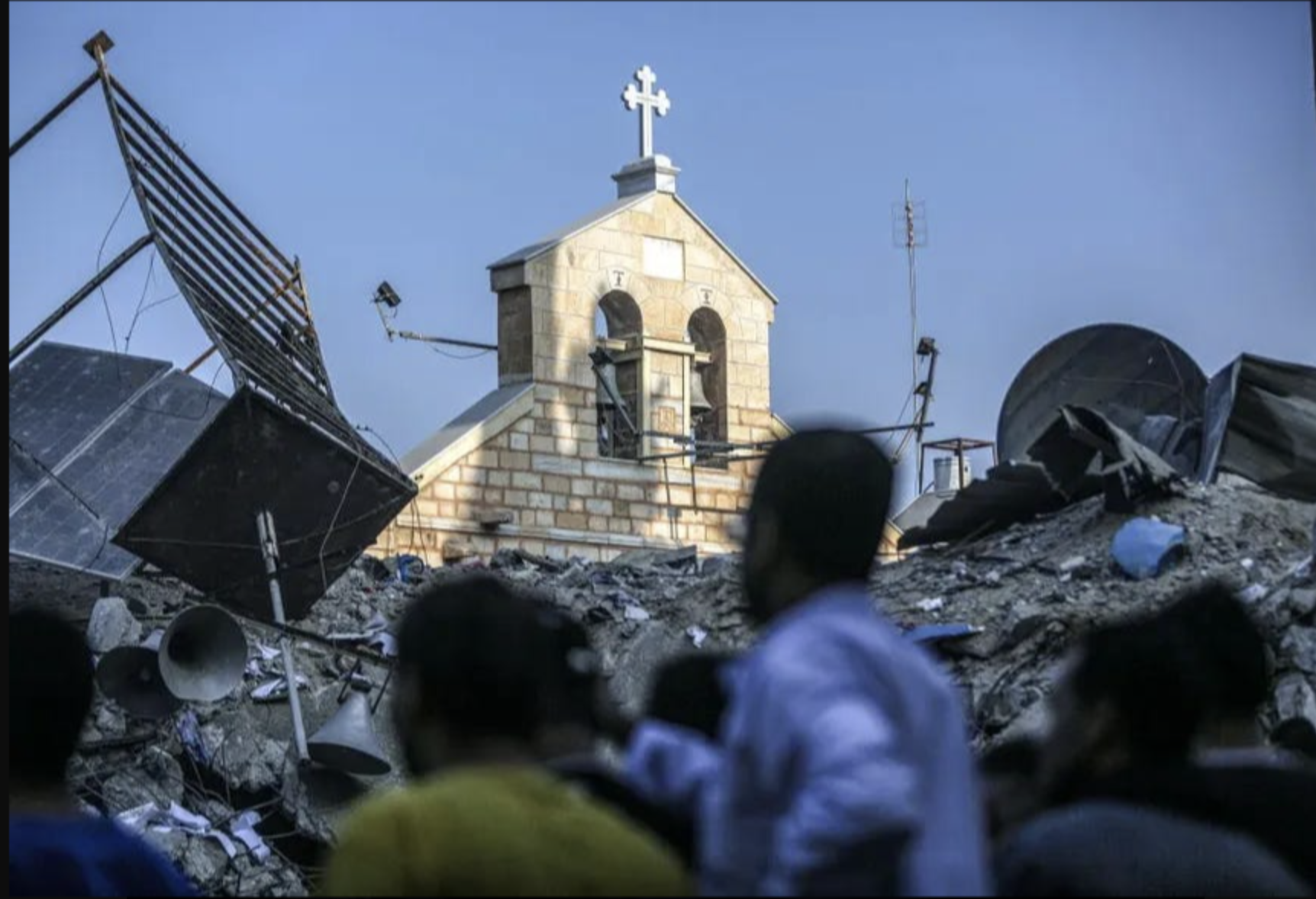
Every day brought worse news: my relatives fled their homes, my mom’s childhood Sunday school teacher’s entire block was destroyed, the Israeli military called the Gaza Baptist Hospital and the churches to threaten them to evacuate, the hospital was bombed, the Orthodox church was bombed, killing our friends and relatives… In desperate need of God’s intervention and closeness, we prayed and cried daily.
When, for a third time, an Israeli airstrike hit St. Porphyrius Orthodox Church where my grandmother was sheltering, I asked my local church in the U.S. to pray.
I sent a prayer request to church staff, detailing the injuries, recalling previous bombings of the church, lamenting the blind eye the world has turned to massacres like this happening every day, identifying that the invading Israelis specifically targeted water tanks which cut our community off from their already limited supply of water, and mourning the deaths of people in our community who died due to lack of access to medical care.
But this long yet frankly limited prayer request didn’t go out to my church in the form I wrote it. Instead, they cut it down to “reflect the immediate need for prayer,” which the self-appointed editors decided was only a sentence lamenting that the water tank was somehow hit, with no perpetrator named.
I was astonished and confused.
I was told that “there was concern that some of the wording might not accomplish what you were hoping for.” I was hoping for prayer. I was hoping for my church to be mobilized to its knees, and to find its duty to intercede and intervene. Are my fellow Christians’ ears so fragile that the truth cannot be transmitted? Does my church even want to intercede? Even if they don’t want to pray—are they willing?
Genocide continues. Israelis have gone on to strike in and around the churches in Gaza several more times during this genocide, to destroy hundreds of other water installations, to damage all hospitals in Gaza, and to block nearly all medical supplies entering Gaza to this day. To mention nothing of their atrocities and ethnic cleansing in the West Bank, Lebanon, and the Naqab.
I take comfort knowing that God heard the whole prayer of my heart. In fact, God hears and cries with the cries of Palestinians in Gaza—the ones that never get transmitted through television cables, nor through church newsletters.
Yet I’m still searching for Christians who will take up our shared vocation of prayer, advocacy, and solidarity with the suffering. I am extremely grateful for those in my church and outside of it who are doing so—maybe you’re one of them, dear reader. But we need so much more.
Truthfully, in perpetrating genocide, humanity has mobilized great spiritual evil. I remain convinced, however—claiming the power of the Resurrection of Christ—that we can and must mobilize an even greater spiritual good that is the hand of Christ.
The full body of Christ must fully embody Christ. That’s how death is defeated.
Jesus prayed for us: “that they may all be one; even as You, Father, are in Me and I in You, that they also may be in Us, so that the world may believe that You sent Me.” (John 17:21)
So, will you join me in asking your church, a friend, or your family: “Will you pray with me?”
Then, together, we may become answers to prayer.

Lydia El-Sayegh (she/هي /ella) is a Palestinian Christian grassroots activist in Atlanta and, newly, DC. Currently, she is working with Quaker lobbyists on Capitol Hill to curb U.S. militarism while slowly pursuing her Master’s in Peace and Justice at St. Stephen’s University. With all the partners she can find, Lydia hopes to build a world where her younger siblings & parents, her community in Palestine, and her global community all experience justice, equity, redemption, and peace.
The views and opinions expressed on the Chasing Justice Blog are those of the authors and do not necessarily reflect the official policy or position of Chasing Justice. Any content provided by our bloggers or authors is their opinion and is not intended to malign any religion, ethnic group, club, organization, company, individual, anyone, or anything.